Bribery. Extortion. Scandal.

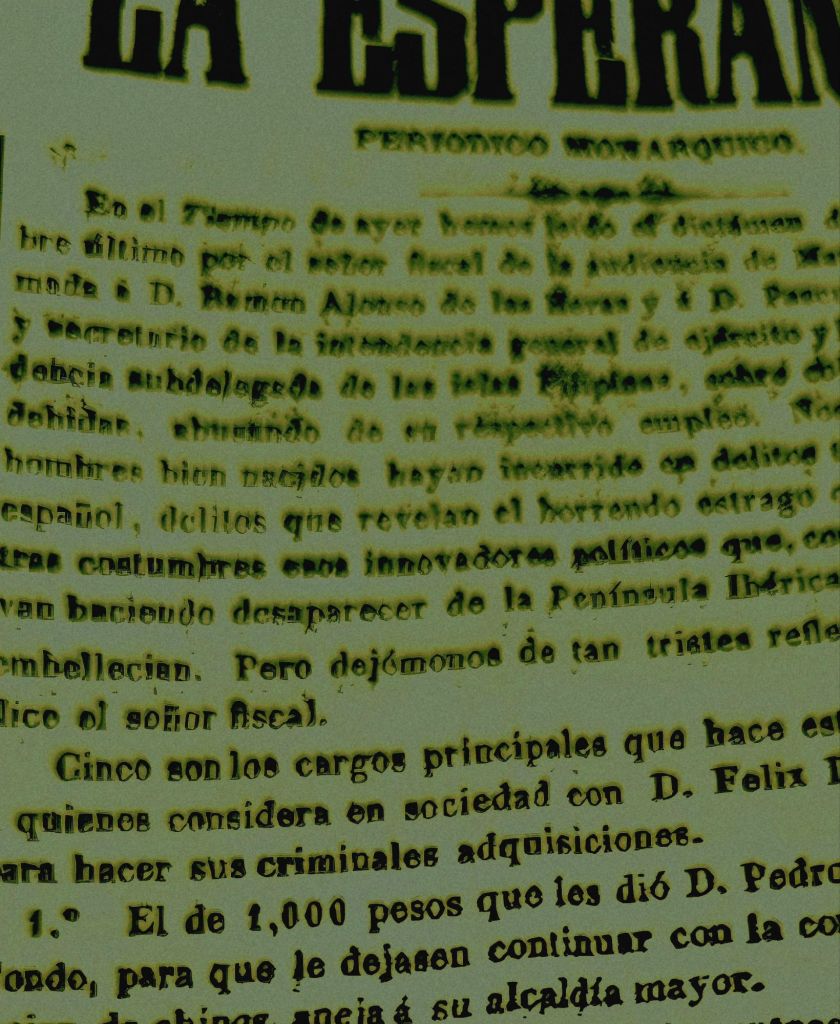
The year is 1844. A pair of Spaniards, Don Ramon Alonso de las Heras and Don Pascual del Castillo, arrive in the Philippines. They have with them almost nothing, virtually penniles on their arrival. Soon they get employed, getting appointed as, and thus, starting to discharge the functions of, confidential officials in the Spanish colonial government on the islands, their office being with the general intendancy in the army and treasury of the government.

Fast-forward three months later, they become wealthy, remitting huge amounts of money back to the Peninsula, i.e., in their native Spain.

In the latter part of the year, a huge scandal breaks out. The pair’s names are dragged in the controversy along with another Spaniard, Don Felix D’Olbaverriague y Blanco, who is a private individual.

The prosecutor at the Audiencia de Manila files five criminal charges against the pair and D’Olbaverriague (who has acted in cahoots with them), alleging the following:

(a) their receipt of a thousand pesos from the chief magistrate of Tondo so that he could continue collecting poll tax from the Chinese laborers,

(b) their receipt of 720 ounces of gold from a private individual so that he could be given priority in government payments,

(c) their receipt of about 15% from the government payments given to Spaniard who is in the military,

(d) their receipt of 1,000 pesos, after their demand, from a private individual who has a pending case in the court of the intendancy, and

(e) their receipt of about 1,100 pesos from two people who then got their promotion to become officers in the office of the superintendency.

So alleges the public prosecutor: the totality of the amount or monetary value arising from the acts of thievery and robbery committed by other criminals throughout the year 1844 does not even come close to the total amount of money pocketed by these trio of bribe-takers and racketeers.

The outraged public prosecutor thus asks the Audiencia de Manila that these accused men be punished, compelling them to return back what they have taken equivalent to four times the amount involved plus legal costs, then imprisonment for four years, and if they fail to so return the money then the prison term be lengthened to eight years, and as to the pair of government officials, they should be ousted from their office and pertually disqualified to any other government post.

So a newspaperman wryly makes the following observation:

It pains us deeply that men who are well-born have committed crimes so unworthy of their Spanish name, crimes that reveal the horrendous havoc they have wreaked on our customs by those political innovators who, with their perverse values, are causing the virtues which the most beautified Iberian Peninsula possesses to disappear.

And what is the denouement of this scandalous state of affairs?
Rizal, Simoun, and The Signed Fili

THE MISSION, as Simoun has planned it, shall take place without fail. Once the incendiary device detonates, the sacks of gunpowder, secretly stashed in the sprawling house once owned by Kapitan Tiago, shall blow up. Death and bloodshed shall ensue.

The powerful blast is the signal and the people shall rise up. And the revolution shall follow.

Alas, Spain’s reign on the islands shall crumble. The denouement shall be as he has mapped it out to be.

As he now leaves the expansive house where the wedding shall be held, Simoun, looking a tad pale, swiftly climbs the carriage parked just outside. Having told the cochero to hurry up, the black-bearded jeweler is certain the blowing up and destruction of the reception hall shall come about while he is en route to The Escolta.

It has been a decade or so from the time the tragedy struck that left his life in abhorrent ruins, his envisioned matrimonial life with Maria Clara having been totally reduced in splinters.

Now is the time of vengeance. The hour of settling scores. And everything is taking place in excellent order.

Freedom from the tragic, nightmarish misery is now at hand.

Or so Simoun thinks.

For the narrative’s plot shall turn out otherwise in conformance with the storyline which the novel’s author,  José Rizal, had at the very start desired.

Simoun’s life shall be cut short, his dastardly plan destined to go terribly wrong.

Simoun a.k.a. Crisostomo Ibarra y Magsalin shall soon die of his own choice, a priest providing comfort to him as he breathes his last in the cleric’s solitary retreat house by the shore of the sea.

THE MISSION José Rizal had in mind would take place devoid of any obstacle. He had sought out permission to serve as an army doctor in Cuba where an epidemic was raging. It was a humanitarian work by which he was to provide medical services to the Spanish army which was battling the Cuban rebels. For the Filipino doctor it was a sincere demonstration that he was not anti-Spanish despite the sufferings he and his family had endured over the years.

In what seemed like an eternity of waiting, the official imprimature was finally given. The celebrated author of the banned novels Noli me tangere and El Filibusterismo ultimately found himself on board a ship that would pass through Spain en route to Cuba.

It was almost half a decade from the time Rizal was arrested and sent on an exile to a Mindanao town called Dapitan. So a banished person he no longer was; he was now on a journey across the vast sea heading to a great new world.

Freedom from the ruthless and corruptive collective powers of the friars and authorities in Spanish Philippines was now at hand.

Or so Rizal thought.

For his life’s narrative’s plot would turn out otherwise in conformity with the storyline which the fates had at the very start desired.

Rizal’s life would be cut short, his offered altruistic gesture destined to go wrong after the authorities in Spanish Philippines had conspired to accuse him of being the brains behind the brewing insurrection on the islands.

José Rizal a.k.a. Pepe a.k.a. Laong Laan a.k.a. Dimasalang would die by the premeditated choice of his persecutors, a priest or two providing comfort to him before he would breathe his last in a spreading field somewhere near the shore of the sea.

HARD TO say, nay speculate, if the last stages in the lives of Simoun and Rizal as spelled out above were indeed pre-arranged similarities. Or if similarities even exist at all.

Be that as it may, what I did was to make a juxtaposition of the events in the last phase of their lives.

Having done such an attempt to draw parallelism, I start to ask myself, Could it be a case of life reflecting art? Rizal’s life taking its cue from his own art?

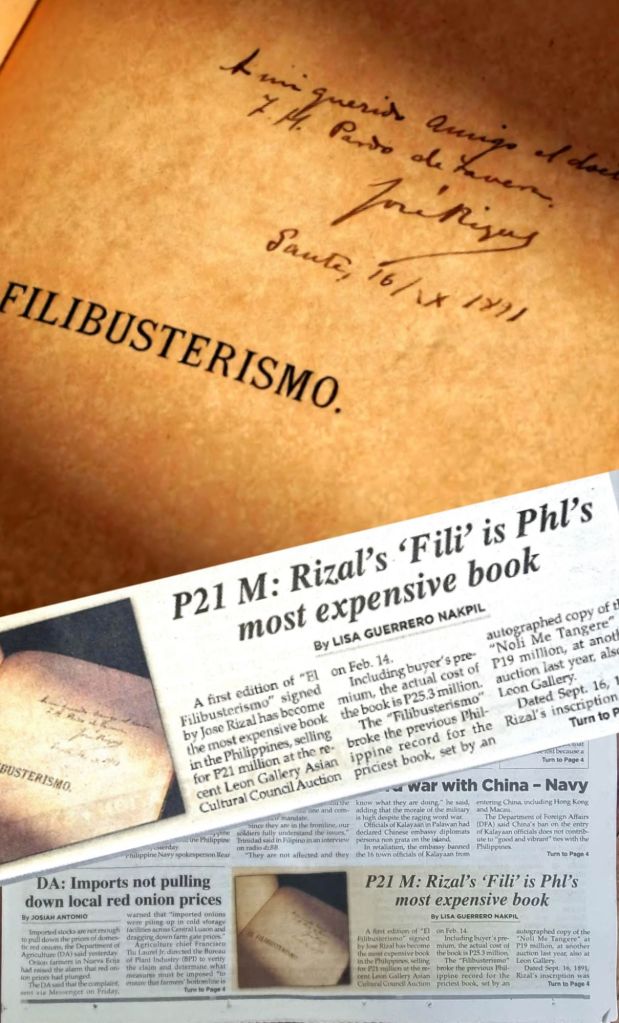
IT IS now about 130 years from Rizal’s execution, or if I would want to state this in acceptably differing words, about 135 years from Simoun’s self-chosen demise, and what has just transpired–just days earlier from the time this blog is written–is a first edition copy of El Filibusterismo, signed by the author himself at the bottom of a short dedication to a dear friend of his, becoming the most expensive book in the Philippines fetching a staggering 21 million pesos as the auction price, the writer of a newspaper piece dubbing the auctioned Fili as supposedly a singular Holy Grail for Filipino book collectors.

THE INCEPTION

This is where it shall begin. The opener. The very first step that shall start the expedition. It shall be an exploration into not just one, not just several, but into an unlimited number of worlds. We’ll make a foray into history. Law and caselaw: the vast swathes of their jurisdiction we shall reconnoitre: we shall ferret out any undisclosed idiosyncrasies and mischievous imps and scamps lurking in the shadows. A tour of literature we shall have to our heart’s content. Voyaging through time, heading back to the past, unearthing experiences long forgotten, pulling out from heaps of lost, squandered years happy episodes of life. However murky the waters of dirty politics maybe, we shall dive into them. We shall wrestle with the burning, hot-button issues engulfing the nation. And the thrilling, scandal-laden showbiz? We shall wade into them. Into the vast horizons of imagination we shall take flight and soar high unstoppably. A roadtrip into the boundless stretch of nature’s terrains. And so on and so forth. Our excursions shall be endless, limitless, untethered, beyond any form of shackles. Come along. Have an adventurous fun with me. Enjoy the ride.