Under the present set up, the highest court in the land is the Supreme Court of the Philippines (sᴄᴏᴘ).
Back in the early part of the 20th century (pre-Commonwealth era,1901-1934), though the sᴄᴏᴘ is the highest court in the land, its decision could be reviewed by the Supreme Court of the US (sᴄᴏᴛᴜs), the reason being the Philippines was still a US colony.
A case in point is the US case 𝘚𝘱𝘳𝘪𝘯𝘨𝘦𝘳 𝘷. 𝘎𝘰𝘷𝘦𝘳𝘯𝘮𝘦𝘯𝘵 (277 ᴜ.s. 189, 1928), an instance in which the sᴄᴏᴛᴜs reviewed the decision of the pre-Commonwealth sᴄᴏᴘ (𝘎𝘰𝘷𝘦𝘳𝘯𝘮𝘦𝘯𝘵 𝘷. 𝘚𝘱𝘳𝘪𝘯𝘨𝘦𝘳, 50 ᴘʜɪʟ. 259, 1927).
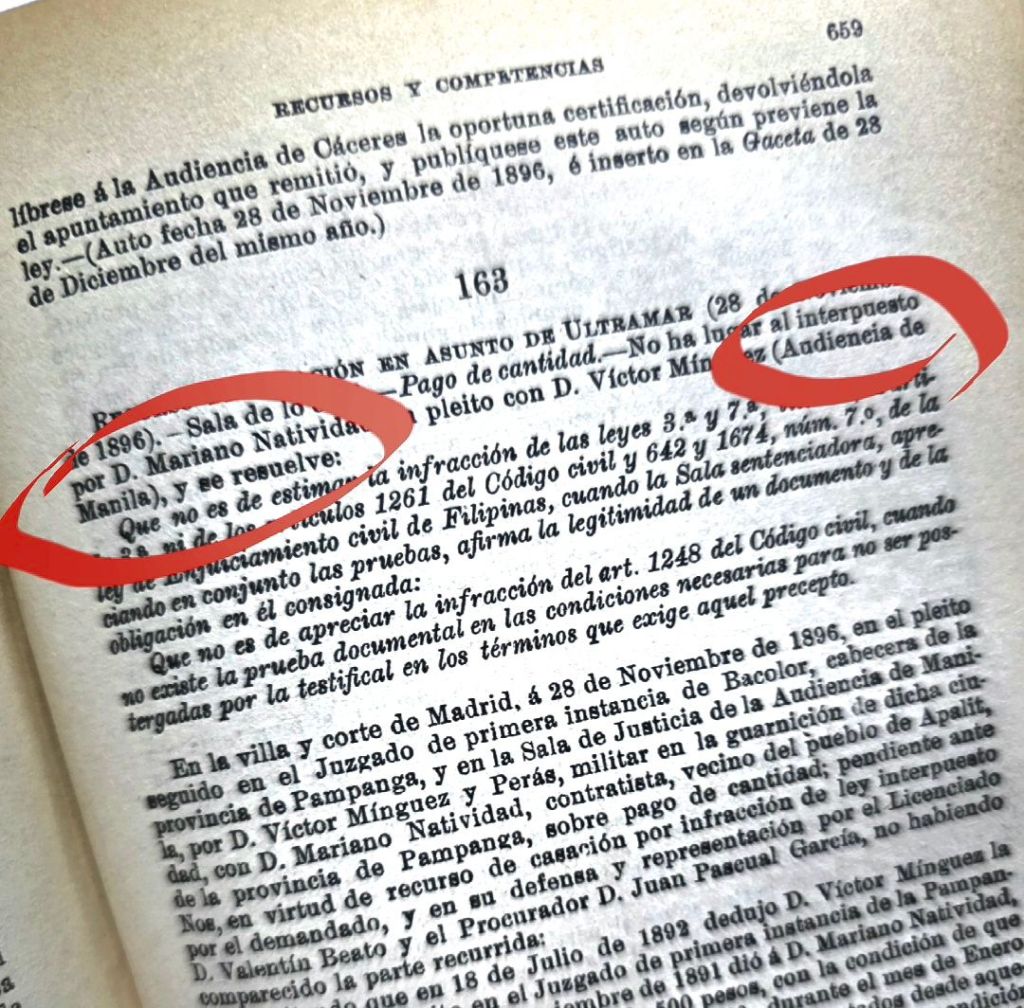
But what about during the time when the Philippines was still a Spanish colony? At that time, the highest court in the land was the Audiencia de Manila (located in the Walled City a.k.a. Intramuros). Its decision could be appealed to the Spanish high court, the Tribunal Supreme.
While we can access decisions by the pre-Commonwealth sᴄᴏᴘ, decisions by the Audiencia de Manila are hard to come by, if not entirely inaccessible. Why? We just do not know, or maybe we could say that, probably, the decisions of the Audiencia de Manila weren’t collated and reported and published into volumes; they were just left to gather dust and were disposed of after the decisions had become final.
Could there still be a tiniest possibility that somehow we here in this generation could access decisions of the Audiencia de Manila? Hard to say.
But in my effort to hunt for decisions of the Audiencia de Manila, I was led to get hold of the decisions of the late 19th century Tribunal Supreme. And, yes, there are caselaw items there that originated in Spanish Philippines–those cases that were decided by courts in the provinces that were appealed by the losing litigants to the Audiencia de Manila whose decisions were, in turn, elevated by the disgruntled parties to the Tribunal Supreme in Spain. In these decisions of the Tribunal Supreme are embedded the decisions, in summarized fashion, of the Audiencia de Manila.
Admittedly, the legal principles laid down by the Spanish Tribunal Supreme in these Philippine cases no longer hold any relevance by now. But for curiosity purposes, or maybe for some bits of historical education for us, we could spend time looking at them.
ʙᴛᴡ, the Spanish word 𝘱𝘰𝘯𝘦𝘯𝘵𝘦 — this was the term used by the magistrates of the Audiencia de Manila and the Spanish Tribunal Supreme to refer to the 𝘥𝘦𝘤𝘪𝘴𝘪𝘰𝘯 𝘸𝘳𝘪𝘵𝘦𝘳 or 𝘳𝘦𝘱𝘰𝘳𝘵𝘪𝘯𝘨 𝘫𝘶𝘥𝘨𝘦 who wrote the decision of the court — has already become part of the Philippine caselaw language.

 a life observer