THE MISSION, as Simoun has planned it, shall take place without fail. Once the incendiary device detonates, the sacks of gunpowder, secretly stashed in the sprawling house once owned by Kapitan Tiago, shall blow up. Death and bloodshed shall ensue.
The powerful blast is the signal and the people shall rise up. And the revolution shall follow.
Alas, Spain’s reign on the islands shall crumble. The denouement shall be as he has mapped it out to be.
As he now leaves the expansive house where the wedding shall be held, Simoun, looking a tad pale, swiftly climbs the carriage parked just outside. Having told the cochero to hurry up, the black-bearded jeweler is certain the blowing up and destruction of the reception hall shall come about while he is en route to The Escolta.
It has been a decade or so from the time the tragedy struck that left his life in abhorrent ruins, his envisioned matrimonial life with Maria Clara having been totally reduced in splinters.
Now is the time of vengeance. The hour of settling scores. And everything is taking place in excellent order.
Freedom from the tragic, nightmarish misery is now at hand.
Or so Simoun thinks.
For the narrative’s plot shall turn out otherwise in conformance with the storyline which the novel’s author, José Rizal, had at the very start desired.
Simoun’s life shall be cut short, his dastardly plan destined to go terribly wrong.
Simoun a.k.a. Crisostomo Ibarra y Magsalin shall soon die of his own choice, a priest providing comfort to him as he breathes his last in the cleric’s solitary retreat house by the shore of the sea.
THE MISSION José Rizal had in mind would take place devoid of any obstacle. He had sought out permission to serve as an army doctor in Cuba where an epidemic was raging. It was a humanitarian work by which he was to provide medical services to the Spanish army which was battling the Cuban rebels. For the Filipino doctor it was a sincere demonstration that he was not anti-Spanish despite the sufferings he and his family had endured over the years.
In what seemed like an eternity of waiting, the official imprimature was finally given. The celebrated author of the banned novels Noli me tangere and El Filibusterismo ultimately found himself on board a ship that would pass through Spain en route to Cuba.
It was almost half a decade from the time Rizal was arrested and sent on an exile to a Mindanao town called Dapitan. So a banished person he no longer was; he was now on a journey across the vast sea heading to a great new world.
Freedom from the ruthless and corruptive collective powers of the friars and authorities in Spanish Philippines was now at hand.
Or so Rizal thought.
For his life’s narrative’s plot would turn out otherwise in conformity with the storyline which the fates had at the very start desired.
Rizal’s life would be cut short, his offered altruistic gesture destined to go wrong after the authorities in Spanish Philippines had conspired to accuse him of being the brains behind the brewing insurrection on the islands.
José Rizal a.k.a. Pepe a.k.a. Laong Laan a.k.a. Dimasalang would die by the premeditated choice of his persecutors, a priest or two providing comfort to him before he would breathe his last in a spreading field somewhere near the shore of the sea.
HARD TO say, nay speculate, if the last stages in the lives of Simoun and Rizal as spelled out above were indeed pre-arranged similarities. Or if similarities even exist at all.
Be that as it may, what I did was to make a juxtaposition of the events in the last phase of their lives.
Having done such an attempt to draw parallelism, I start to ask myself, Could it be a case of life reflecting art? Rizal’s life taking its cue from his own art?
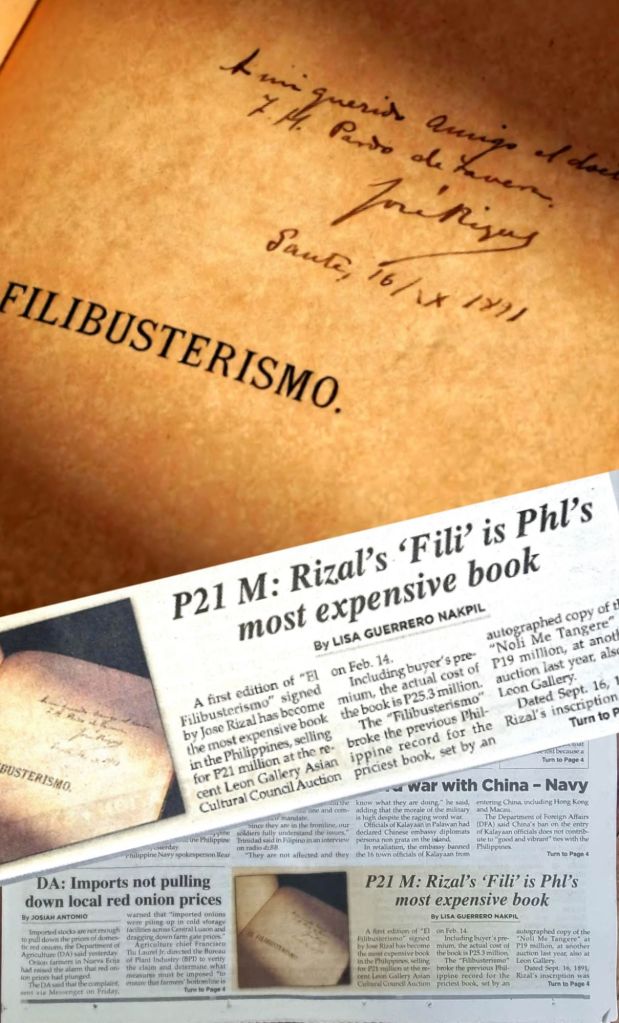
IT IS now about 130 years from Rizal’s execution, or if I would want to state this in acceptably differing words, about 135 years from Simoun’s self-chosen demise, and what has just transpired–just days earlier from the time this blog is written–is a first edition copy of El Filibusterismo, signed by the author himself at the bottom of a short dedication to a dear friend of his, becoming the most expensive book in the Philippines fetching a staggering 21 million pesos as the auction price, the writer of a newspaper piece dubbing the auctioned Fili as supposedly a singular Holy Grail for Filipino book collectors.

 a life observer